Duskgild · Field notes
Memento Mori Jewelry
Memento mori is Latin for remember that you must die. It reads like a threat. It was meant as a favor. For two thousand years people have kept a small skull close — cut into a ring, hung at the throat, hidden in the lid of a watch — not to sit with the end, but to sharpen everything before it.
This is a plain account of where the phrase comes from, what its symbols say, whether it's as grim as it sounds, and how to wear a piece now without looking like you're in mourning.
What memento mori means
Translated flatly, memento mori is "remember (that you have) to die." The idea underneath the Latin is older than the words: a person who forgets they are mortal tends to waste the time they have, and a person who remembers it tends to spend that time better.
So the skull is not an argument for despair. It's an argument for attention — a small, blunt reminder, worn where you'll catch sight of it, that the day in front of you is finite and therefore worth something.
A short history, told straight
The Romans built the reminder into their proudest moment. When a victorious general rode through the city in a triumph, tradition holds that a servant stood behind him in the chariot, amid all the cheering, and repeated a single phrase: respice post te; hominem te memento — look behind you; remember you are only a man. The greater the honor, the more they thought he needed the ballast.
The Stoic philosophers turned it into a daily practice. "You could leave life right now," Marcus Aurelius wrote to himself. "Let that determine what you do and say and think." Seneca kept the same idea from the other side: we don't suddenly run out of time so much as spend it without noticing.
When plague emptied whole towns, medieval Europe answered with images that refused to look away — the danse macabre, where skeletons lead pope and pauper off together in the same line, and the vanitas still lifes, a skull set among the fruit and the flowers to say that all of it spoils.
The jewelry we now call memento mori took its clearest form under the Victorians. When Prince Albert died, Queen Victoria wore mourning for the rest of her life, and much of a nation followed her into it. Rings, brooches and lockets carried skulls, urns, weeping willows, a coil of the dead's hair kept under glass, a name and two dates. It was grief made wearable — and, quietly, a reminder to whoever was still living.
The symbol never really left. It returns wherever people go looking for a way to hold onto their own time: in the Stoic revival, in tattoo work, and in dark jewelry that wants to mean more than decoration.
The symbols, and what they carry
Memento mori has a small, old vocabulary. A few shapes do most of the talking.
- The skull. The plainest of them — mortality with the flesh taken off. Worn well, it reads less as menace than as candor.
- The crescent moon. Time in a shape you can see: it waxes, it wanes, it never holds still. In our own pieces it sits above the skull like the last of the light.
- The opal. A stone that seems to keep a fire inside it — light held in something you can wear. It's why we set one over the Vigil skull: a small, shifting flame above the bone.
- Thorns and roses. Beauty that costs something. A vine of thorns makes the same case a skull does, only gentler — that what's alive is worth the hurt of holding onto it.
- The coffin. Read quickly, it's an ending. Read the way it was meant, it's closer to the opposite — a six-sided shape that stood, in old symbolism, for something that outlasts the body.
Isn't it morbid?
It's the first question people ask, so here's the honest answer: no — or at least not the way they mean. The point of memento mori was never to fixate on dying. It was to stop sleepwalking through living.
The Victorians who wore it weren't ghoulish; they were comforted by it. A skull on your hand doesn't darken the day. If anything it does the reverse — it's hard to waste an afternoon you've just been reminded is numbered. Worn plainly, against ordinary clothes, a memento mori piece looks less like a costume and more like a quiet, private argument with your own distraction.
How to wear it
None of this works if the piece looks like a Halloween prop. The trick is restraint. A signet ring in oxidized silver reads as something inherited, not something bought for a party. A pendant sits under a collar, seen only when you decide to show it.
Let the piece be the one dark thing in an otherwise plain outfit and it carries weight; pile it in with ten other gothic pieces and it turns to noise. Oxidized silver helps here — quiet and grey at arm's length, sharp with detail up close. And wear it every day, not once a year. That's the whole idea.
What to look for
If you're buying one to keep, a few things separate a piece that ages well from one that flakes.
- Solid metal, not plating. Plated and stainless pieces look the part until the finish wears through. Solid 925 sterling silver takes an oxidized finish that actually improves with time — the darkened recesses deepen, the raised silver polishes bright against them. The theme and the material end up agreeing with each other.
- Made, not stamped out. A memento mori piece is meant to be kept, and ideally handed on. Made-to-order and handmade work carries that intent in a way warehouse stock doesn't.
- Stones you can stand behind. Lab-created stones give the same fire as mined ones without the murk of sourcing, and they come out consistent from one piece to the next.
Weight is the quiet tell. A real one has heft.
Memento mori, the Duskgild way
Our whole shop is built on the idea. The Vigil Signet skull ring is our clearest statement of it — a sculpted skull keeping watch under a crescent of black pavé, a lab-created opal riding above it like the last light. The Vigil Pendant skull necklace is that same watch, worn at the throat. Both are solid 925 sterling silver, oxidized by hand, and made only once you order one — never before. For what the skull itself means — memento mori, mourning, defiance, and the rest — see our note on skull ring meaning.
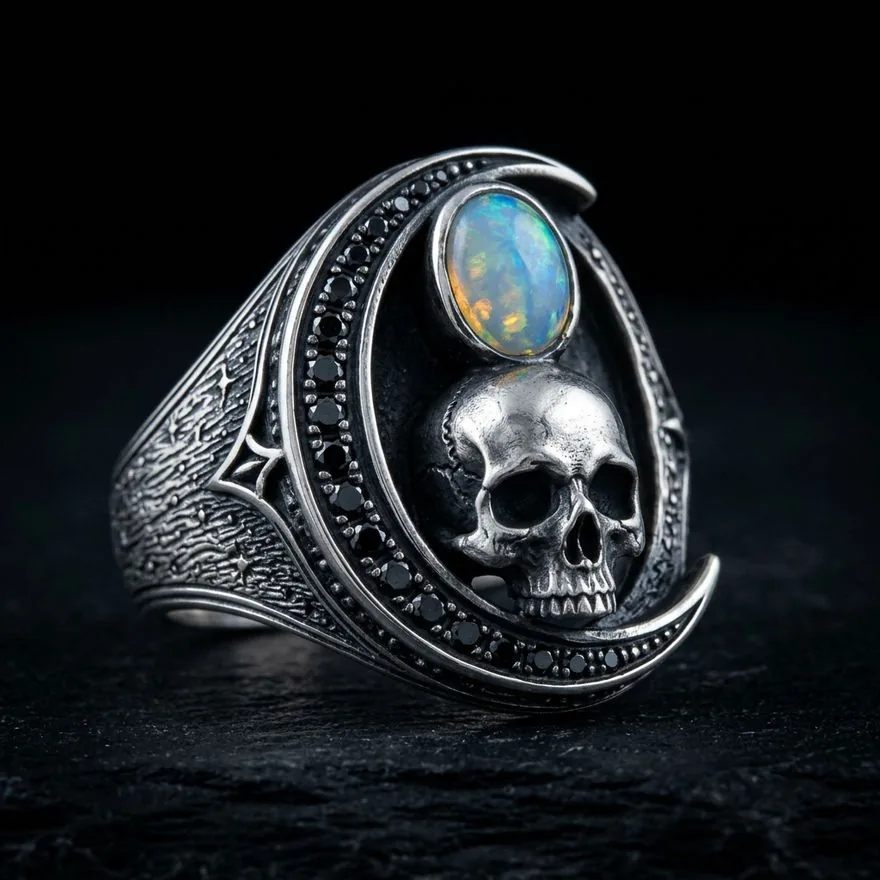
Vigil Signet
925 silver · black pavé · lab-created opal · oxidized
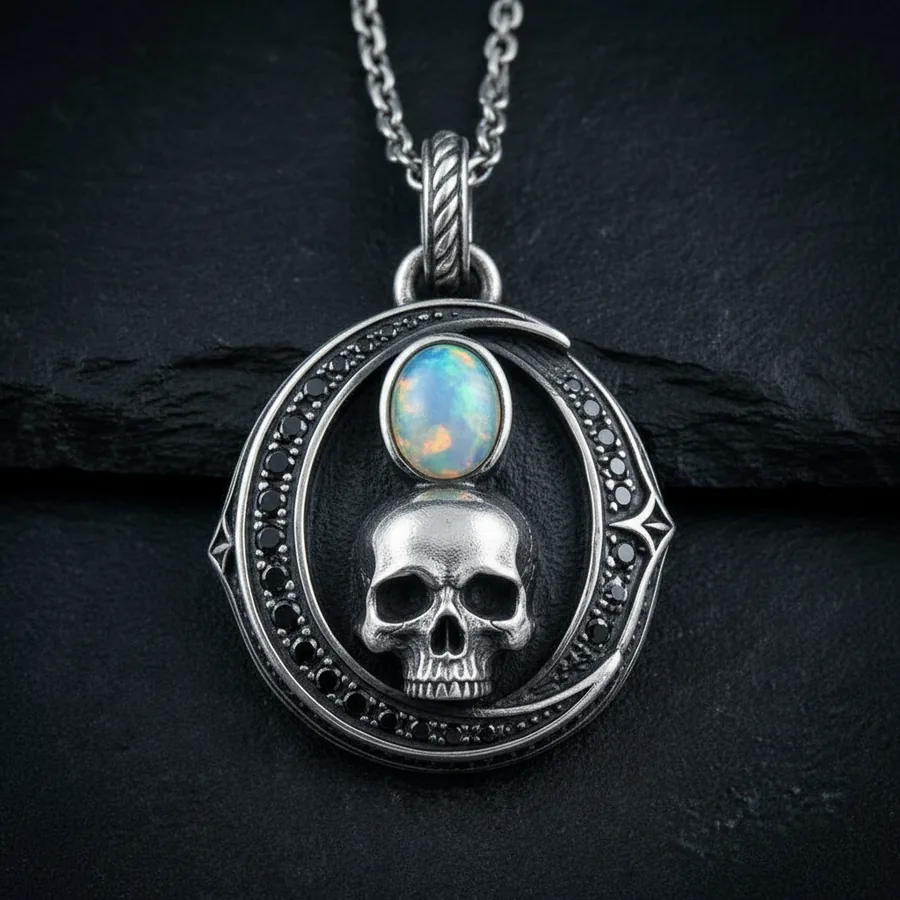
Vigil Pendant
925 silver · black pavé · lab-created opal · oxidized
Common questions
What does memento mori mean?
It's Latin for "remember that you must die" — an old reminder that life is finite, meant to make you value the time you have rather than dread its end.
Is memento mori jewelry religious?
Not necessarily. The idea runs through Stoic philosophy, Christian art, and plain secular life alike. You can wear it for faith, for philosophy, or simply as a reminder to pay attention.
Isn't wearing a skull morbid?
The intent is the opposite. Memento mori is a prompt to live fully rather than dwell on dying — the Victorians who wore it found it steadying, not grim.
Is it only for men?
No. Memento mori jewelry has been worn by everyone for centuries, and the symbols aren't gendered. It's a matter of the piece, not the wearer.
What metal is best?
Solid sterling silver (925) is the traditional and most forgiving choice. It takes an oxidized, antiqued finish that suits the theme and only looks better as it ages — unlike plated or stainless pieces, whose finish wears through.
Does it make a good gift?
Yes, when the person understands it. Given with a word of explanation, it's one of the more meaningful things you can give — a wish that someone live fully, not a death omen.
Made to order, in solid silver
Every Duskgild piece is cast in solid 925 sterling silver and made only once you order it. See the full register.
See the designs Enter the shop